
Thursday, June 13, 2013
CARIB SONG 9/27/45

CAROUSEL 4/19/45

Saturday, October 13, 2012
Up In Central Park 1/27/45

Tuesday, November 15, 2011
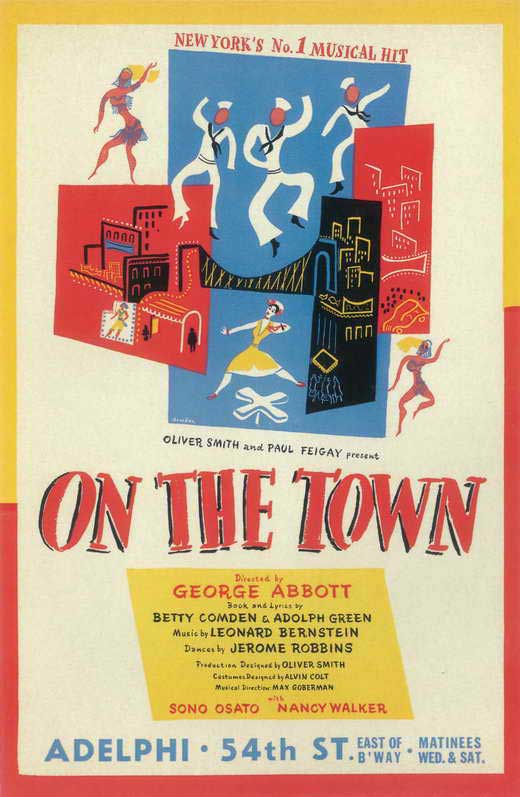
ON THE TOWN 12/28/44
Friday, November 11, 2011
SING OUT, SWEET LAND! 12/27/44

Ok. This one was a shocker. Maybe it's because I'm really into folk music right now, but I found this cast album to be thoroughly enjoyable. Traditional broadway singing, blues, soul, folk... this has is all. And the year is only 1944! This show was an Americana folk revue. It didn't even run that long. Fresh off of the success of OKLAHOMA!, Alfred Drake shows off his glorious voice ("Where" is particularly great- his crescendo on the last note is pretty impressive). I love the blues songs on side B with Juanita (Bali Ha'i) Hall and the 'spiritual ensemble' (????). The highlight for me, however, is Mr. Burl Ives. Of course we all know his Christmas album. In fact, that's all I knew of him. Little did I know that his roots were in the folk musical world, which is how he was showcased in this musical. With a simple guitar accompaniment, he delivers in a silk voice some of the best old folk songs I've heard. Truly a highlight. I wish the whole record was him singing folk songs. But then, that isn't very theatrical and cast recording-like. Which could be my one quibble. This is a great cast recording, but the songs really are just popular songs of the day (or past 100 years) and don't further any discernible plot at all.
GRADE: B+
Tuesday, November 8, 2011
Bloomer Girl 10/5/44

Harold Arlen has always been one of my favorite composers, and this score certainly confirms it. I'm definitely going to be listening to this show more often. By no means is this a cd of perfect performances. Joan McCracken is obnoxious on her comedy songs. I feel like the speaker is nagging at me while I'm listening to her sing "T'Morra' T'Morra'".... MAKE IT STOP....
However, the other songs are so beautiful on the ears. Fantastic orchestrations by Robert Russell Bennett. Celeste Holm is quite charming, although I prefer her comedy to her legit singing. "The Eagle and Me" is a highlight. There are a couple musical passages that are just stunning- the strings in "Sunday in Cicero Falls" for example. It's also fun to hear Harold Arlen himself singing "Man For Sale".
GRADE: A-
Saturday, October 16, 2010
SONG OF NORWAY - studio

I'm so glad I listened to the other SoN first before this one. Irra Petina , who was the star of the original, was not let out of her recording contract to do the Decca cast recording with the rest of the company and orchestra. Columbia decided to release an album with her singing her songs from the show. I can't say I'll ever wanna throw this record on to hear the show. It's not really fair to compare the two offerings since the Decca album is more of a OBC album, while the Columbia/Petina is more of a solo album. I can't imagine her with the rest of the original cast; her voice is too thin and stringy to me- especially when she sings the last high note of each song. I find it interesting that the orchestrations are not the same as the original. Some sections I like better, but overall I'd rather hear what was played in the theater. This album embodies everything I thought Song of Norway was going to be before I actually heard it: lofty, boring, too operatic, no acting, etc. I'm glad I've got the other album to show me that it is in fact interesting, fun, and theatrical.
Grade: C-
SONG OF NORWAY - 8/21/44

What an awesome cast album. I had no idea this is what it would be like. I've had a two disc studio recording for over ten years and I never could make myself listen to the damn thing. Now, however, I'm singing a different tune. This original cast album (minus the female star, Irra Petina) is the first I've heard that convincingly interpolates singing and speak, back and forth, in such a natural manner. Yes, they sing in a much loftier way, but I don't mind since it is seemingly act-able. This is considered an operetta, but I'm calling it a legit musical. Robert Shafer, who leads off the album, has an incredible tenor voice. The ending of the opening made me applaud from my reclined leather man-chair. Incredible. Also, I've never heard Kitty Carlisle sing like this, and I like it. The songs never bored me. Like I said, I've always had this impression that it would be an utter snooze fest. This is simply not the case. The melodies are very theatrical; they soar when they need to soar and get quiet when they need to be quiet. I'm excited to listen to the next recording of this starring Irra Petina, who wasn't allowed to record with a different record company from the one she was signed to. Stay tuned.
GRADE B+
Thursday, October 14, 2010
MEXICAN HAYRIDE - 1/28/44

This album is pretty amazing. The first track, Sing To Me Guitar, blew me away the first time I heard it. I literally stopped everything I was doing and just listened. I love the way the strings weave into the guitars so seamlessly. Great orchestrations. But why is June Havoc impersonating Ethel Merman? She keeps doing those little flips on the first note of each phrase. ie. Ethel's "There's nnnnnnnoooooooOOO business like shoooooOOOOOw business",... I don't know if that's how Havoc really sang or not, but it seems copycat-like. That being said, I love hearing Wilbur Evans singing this kind of material. I first noticed him in the studio recording of MERRY WIDOW, but this now furthers my interest. Other songs on the album are fun and typical Porter. It isn't his best score, but it certainly isn't the worst. The show was a success at the time, running over a year. I find it strange that Bobby Clark was the star of the show, but he doesn't appear on the recording at all. Speaking of; this recording is particularly worth having if just for the bonus material. Mary Martin sings six fantastic Cole Poerter songs.
Grade B+
Wednesday, October 13, 2010
THE MERRY WIDOW - 1943 Studio

Studio recordings were just starting to be made in the mid-40's. Once record companies started making money from cast recordings like OKLAHOMA! they started putting singers together to make money on other older shows that never got a proper recording. Operettas were so popular in the early 20th century, but hardly any of them where recorded in tact back then. Operetta was still going pretty strong at the outbreak of WWII, but audiences were starting to learn that musicals would give them acting, dancing, singing, AND storytelling throughout. Thus, musical comedy started to take the place of both operetta and vaudeville. Lengthy dissertations could be constructed discussing the reasons that musicals over took operetta in popularity, but I won't even attempt to explain that here. I'll leave that for my Masters degree. For now, we have Kitty Carlisle singing The Merry Widow. She sounds fine. I'm not sure if I love her voice on this; sometimes it sounds a little thin. Wilbur Evans has an interesting sound and performance. Think Marc Kudisch. A 1920's version at least. Every time I hear him sing I think of that. I'll look forward to hearing his voice on other shows and recordings. I like the songs well enough. Overall, it is a decent representation of this popular operetta. I can't say I'll listen to this studio recording all the time, but it embodies the general sound of that specific musical era to me-especially since we don't have many pre-1940 operetta recordings.
Ps. Did you know that 'merry widow' also refers to the lingerie number showed above? HOT.
Grade: B
Tuesday, October 12, 2010
CARMEN JONES - 1943

What an interesting listen. Carmen Jones was quite the success of it's year, running over 500 performances. Maybe it was an escape from the war. Maybe it was the opera tunes pretending to be musical theater. Maybe it was the all Black cast. Who know? But listen to 'Dis Flower' and tell me that isn't musical theater? It's incredible to me how these opera songs make the transition. Yes, there are the familiar tunes you know from pop culture. For me, it's the rarer known ones that are the most interesting listen. Of course, there are are the painfully of date 'dem's and 'der's, but it's not that bad. Overall, Hammerstein succeeds in making plot moving songs out of arias (which are written to pontificate on one idea the whole song). Rarely do they actually further the plot. Here we have songs that give us information and feelings, and also further the plot. The singing is ok, not the best. There are a couple stand alone solos, but there is a final soprano note in a group number that is particularly bad...otherwise it's all passible. Sometimes the singing is muddy and I can't hear the orchestra, but that might be the dated recording techniques. Either way, I'd like to listen to this again with a cleaner/newer recording. Ps. The bonus track is interesting... Kitty singing all the 'dem's and 'der's makes me feel kinda funny...
Grade: B+
Tuesday, October 5, 2010
WINGED VICTORY - 1943

This isn't a cast album, so I'm a little loathe to type this up; I've typed it up, so I might as well. There a couple solo's on here. They are fine. Most of it is chorus stuff that is quite melancholy. This was really a Moss Hart play with some music added. It takes place, you guessed it, in the air force division. It seemed everyone wanted their own THIS IS THE ARMY. So they got it. It lasted for a while and was very successful, recorded in Hollywood as well. I won't listen to this just to hear the songs, but the record (with Song of Norway, and Up in Central Park) is a nice send back. I'll listen to the other shows presently. I'll just this as a separate show, not the whole album.
Grade: C (but the album so far is a solid B)
Thursday, September 30, 2010
A Connecticut Yankee - 1943

Thank you Mr. Rogers for putting this revival together. Story has it that it came about mostly to keep Hart from being self destructive. The sad news of course is that once the show opened, Hart went back to his old ways and passed away less than a week after opening. Very sad. But let us not get too bummed out. The man left a legacy. His lyrics are in a league unto their own. The wordplay in songs like "To Keep My Love Alive" are unparalleled. The singers are all wonderful, especially Vera-Ellen. What a quirky little voice. I'm sure she was a hoot to watch on stage (or screen). The sound quality on the album is fantastic. I love these re-mastered decca re-issues. The liner notes are so detailed and lengthy, complete with pictures from the productions. This recording captures Rogers and Hart for me in all the best ways: lyrics. music. arrangements. the singers. sound quality. All superb.
Grade: B+
One Touch of Venus - 1943

More like... One Touch of MARY MARTIN. She sounds just incredible on this album. Who knew she could belt? Listen to the end of "I'm a Stranger Here Myself". Wow. This is one of my favorite cast albums I've heard so far. Nash could write some funny, witty lyrics. I wish he wrote more shows. The music is some of Weill's best work thus far. I even love the orchestra tracks (the ballet music). Weill did all the orchestrations himself (as if this were an opera...) and they are magical. I especially liked the Forty Minutes for Lunch music. Ms. Martin brings such charm to her songs. You gotta love a singer who can justify a portamento on just about every other phrase. It works somehow. No one else could do that and get away. And is she mixing? Head voice? It's that weird thing ladies could do back then... sound like they are belting, but it's really just head voice. I'm sure it had something to do with having to project in the big theaters without mics. Merman does the same thing. I love it. I don't know much about Kenny Baker. It seems he didn't do any other Broadway shows, and sings on a just a couple other albums. This is NOT the Kenny Baker who played R2D2 in the Star Wars movies.... just to clarify. But wouldn't that be awesome if they were one in the same? Anyway, the Kenny who sings here is just great.
Grade: A+
Oklahoma! 1943

Well. I've done it. I've actually gotten to the Golden Age of Broadway. OKLAHOMA! marks the start of something very special in the history of musical theater. Singing. Acting. Dancing. All three come together to tell the story AND further the plot through the use of lyrics to express how the characters feel. I could go on and on about the show and the impact is had, but you can read all that in the books and on the albums. I want to talk about this recording and that's all...
As soon as you hear the down beat of the overture you realize that this is a show not like anything we've heard so far. Consider all the Porter shows of the previous decade. Nice, light, fluffy shows and plots and songs and characters. OKLAHOMA!'s songs never sound dated or boring. They are still exciting after all these years-- all of them. (Even It's a Scandel...)
This is actually one of the first times I've listened to the OBC of this show. Of course, it's quite good. Of particular interest to me is the fact that OKLAHOMA! was one of the first shows to record an album not only to commemorate the show, but to make money off it through album sales. I've always like Alfred Drake, his voice just shines in these songs. Celeste Holm makes me laugh when I hear her sing. I can just picture her delivery, and it cracks me up. Joan Roberts is fine, her voice sometimes not warm enough for me. The Bennett orchestrations are, of course, just brilliant. It's nice to be able to hear them so clearly. It's exciting to listen to this album not only for the historical implications, but it sounds so damn good too.
Grade: A
Thursday, September 23, 2010
Something For The Boys - 1943

You wouldn't know from listening to this album that SOMETHING FOR THE BOYS was a big fat hit in 1943. Granted, not the kind of earth shaking hit OKLAHOMA! was a couple months later- but a hit nonetheless. The songs are all pretty lackluster, and just a bit cliche. I also wouldn't have guessed that this is the same writer who would create KISS ME, KATE in just a few short years. I feel like Mr. Porter popped these little tunes out in his sleep. None are particularly memorable. Maybe 'Hey, Good Lookin', but only because my Mom used to sing it when I was a kid (she might actually still sing when given the proper cue). I like the dialogue lead ins to the songs, but they often betray the fact that the songs don't really further the plot. Not like the way they do in KATE. Ethel sounds great, but still doesn't do much for me. The lyrics on the album can sometimes be difficult to understand. I read somewhere that this isn't actually a cast album, but rather some radio excerpts compiled onto an album. I think my favorite song is 'Could It Be You'. Overall, the sound is classic fluffy Porter. Classic brassy Merman. Grade: C
This is the Army - 1942

THIS IS THE ARMY was a true reflection of the times. The country was in the thick of war; soldiers and Americans alike needed to be entertained and celebrated. Enter Irving Berlin writing a soldier musical, much like he did during World War 1 (Yip! Yip! Yaphank). War type novelty songs sung, arranged, conducted, directed, etc... all by soldiers. As if that wasn't good enough, all proceeds went to US war relief funds and charities. Millions and millions of dollars. All the while, Mr. Berlin (actually, Sgt. Berlin) stayed with the production. I am just blown away by the service he did for America. Can you imagine something like this today? There is no way it would ever happen. Soldiers don't write musicals, let alone act in them, any more. Yet here is Berlin at the top of his game donating his time and energy to the US, through the form of art.
The album itself is quite good. It is paired with CALL ME MISTER, which I'll get to later. This 2002 re-release has fantastic liner notes. The tunes are all so melodic, and all seemingly based on very army-like tunes. The overall feeling is very masculine. Is that possible for an old musical? This show captures it. Every section of the military gets a shout out. Army, Navy, Air Force. There's even a number for the black soldiers, something that was not often done in an all white musical. If Berlin was no longer improving on the form of musical theatre, he certainly was always celebrating it. Witty lyrics abound. Tight melodies. And who did these orchestrations? All uncredited. For me, the highlight on this recording is whenever Sgt. Berlin is singing. His voice is almost mouse like, but so funny. It makes me smile.
Grade: B+
Monday, September 13, 2010
Let's Face It 1941

I love Cole Porter. Especially on the record player. When I think of the music of the 30's and 40's, I think of Cole Porter. Once again, Danny Kaye is up to his old tricks. Well, the tricks were kind of new at this point. He was just starting to become a star. He had two specialty songs (that Porter did not write) in the show. One of them being, Medoly in 4F. It's weird. I don't know what else to say about it. I think you had to be there. The rest of the songs are lovely, funny, and quirky. They don't seem to further the plot that much, but who cares. The country was at war and people needed to be entertained. This did it. Overall grade: C+
Tuesday, September 7, 2010
Lady in the Dark 1941
This could be considered a play with music. There are three extended dream sequences where all the songs occur. Gertrude Lawrence's character has problems and she seeks out a analyst to get some help. They figure things out by looking at her dreams (and singing some songs too). This musical was way ahead of its time. There is a note by Moss in the score where he says that he and Weill deliberately set out to NOT create a traditional broadway musical comedy. Well. They did it. I'm surprised that this show isn't done more.

I find this score enchanting. The recording is by no means a complete cast recording. At least we get an idea of what the original production was like. I hate to say this, but I think Gertrude Lawrence was a you-had-to-be-there-to-get-it kind of performer. She sounds just ok on the recording, and yet she was hailed at the time for being an astounding performing. There is one song that isn't from the dream sequence which is the final song, My Ship. It's a lullaby that the character Liza has spent the whole show trying to remember. The melody is perfection. Just beautiful. Yes. There is also the Russian composer patter song that made Danny Kaye famous. This doesn't really do anything for me. I guess at the time it was a big deal to hear someone rattle off a bunch of strange names in like 39 seconds. A fun listen overall. I'm looking forward to hearing contemporary recordings of it.
Grade B

I find this score enchanting. The recording is by no means a complete cast recording. At least we get an idea of what the original production was like. I hate to say this, but I think Gertrude Lawrence was a you-had-to-be-there-to-get-it kind of performer. She sounds just ok on the recording, and yet she was hailed at the time for being an astounding performing. There is one song that isn't from the dream sequence which is the final song, My Ship. It's a lullaby that the character Liza has spent the whole show trying to remember. The melody is perfection. Just beautiful. Yes. There is also the Russian composer patter song that made Danny Kaye famous. This doesn't really do anything for me. I guess at the time it was a big deal to hear someone rattle off a bunch of strange names in like 39 seconds. A fun listen overall. I'm looking forward to hearing contemporary recordings of it.
Grade B
No for an Answer 1941

This is an interesting listen. Billed as an opera, it isn't really opera. The songs are smart like you'd expect them to be. I'm amazed that the show was even recorded. It ran 3 Sunday nights in January at the City Center (Called the Mecca Temple at the time), so it really isn't even a Broadway show. This is a true cast album. We're still pre-Oklahoma!, so it's still rare to have a recording made simply to preserve the production.
Blitzstein is playing the piano. A VERY VERY young Carol Channing (still an undergraduate) singing some pop parody songs. Everyone once in a while you can hear the Carol that she'll become two decades later. The song 'Francie' is pretty awesome. The fellow returns from prison and is so freakin excited to see his woman that all he can do is sing her name, and them just hum. She speaks in between his name calling. Way ahead of its time. I love the integration of dialogue into song. According to the liner notes, the singers where hired to be actors first. Think: actor's who sing. Something not very common at the time. Once again, Blitzstein very quietly pushing musical theater to another lever.
Grade B-
Subscribe to:
Posts (Atom)